
Precision PneumaticMulti Clamp EOAT
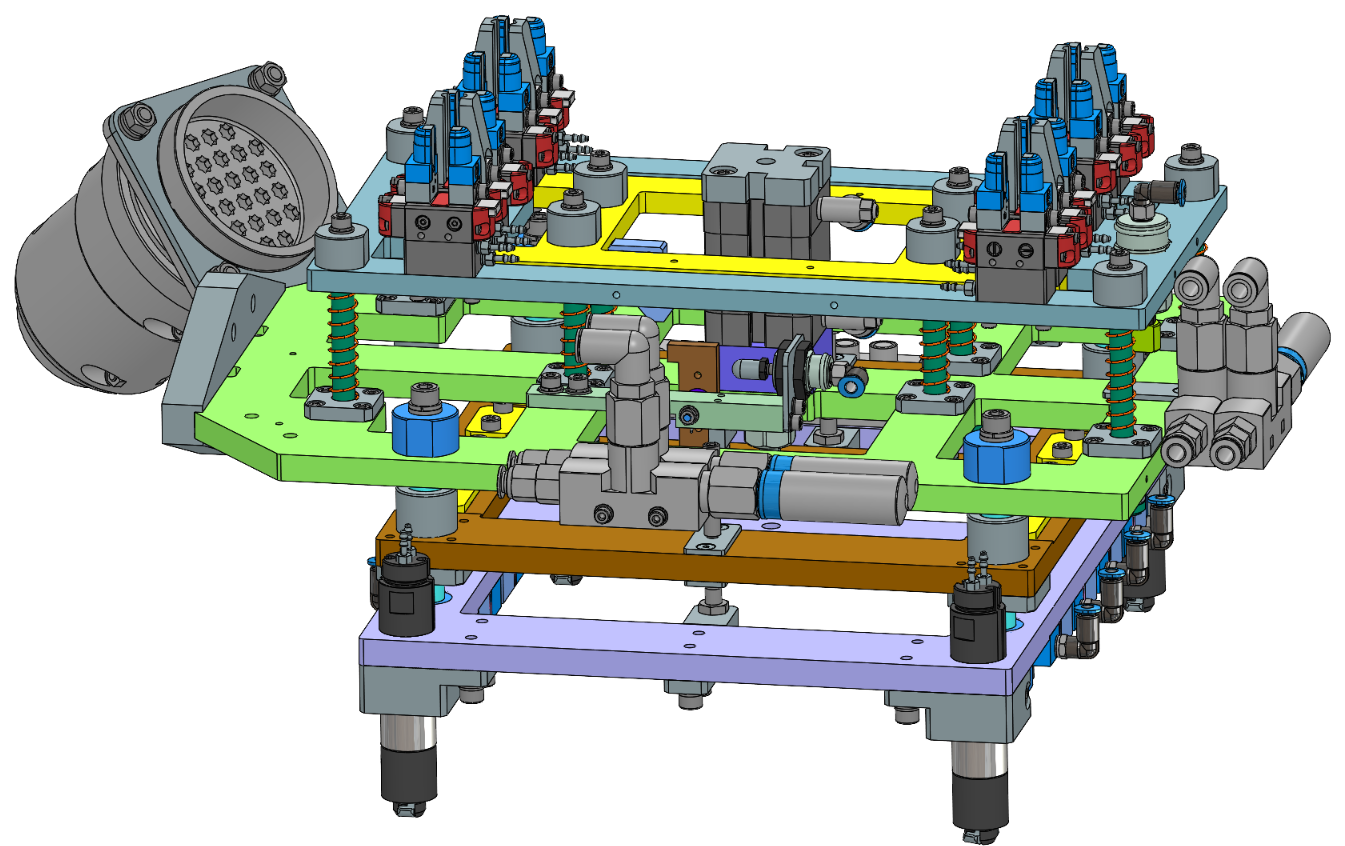
A compact robot tool combining distributed pneumatic clamps, compliant seating and a rigid nested frame to locate, retain and transfer a component in a repeatable robot referenced pose.
Locate the part before moving it
The handled component required substantially more geometric control than a simple two jaw or vacuum gripper could provide. Multiple local clamping stations allow it to be seated, referenced and retained at several points before robot motion begins.
The engineering objective was therefore not gripping force alone. The EOAT had to establish a controlled relationship between the component and the robot tool frame so the part could be transferred between defined process datums.
Compliance during seating, restraint for transfer
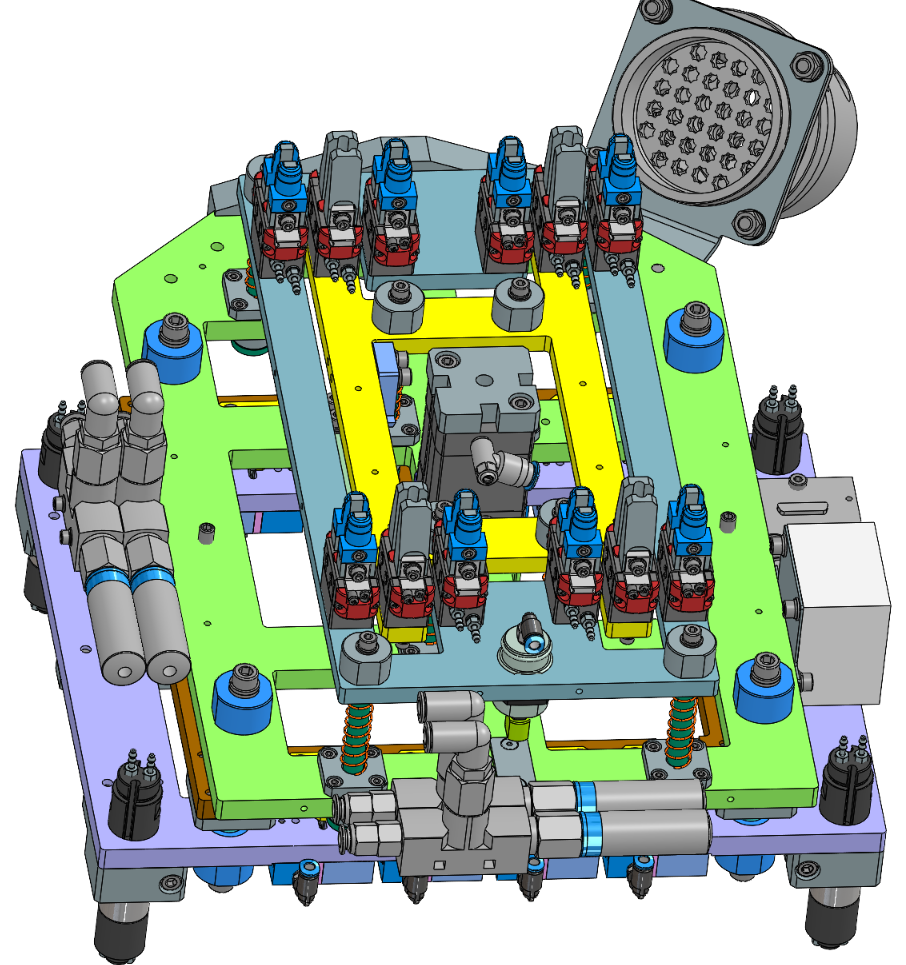
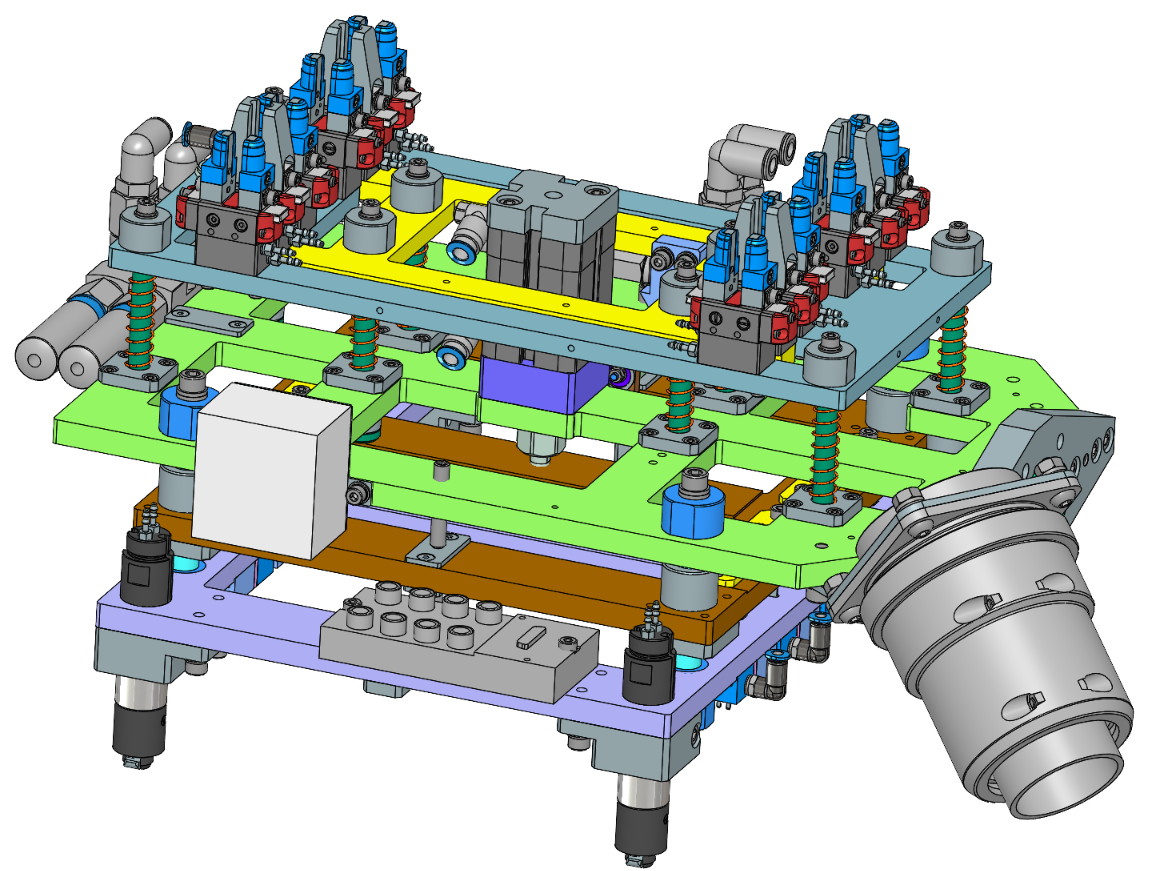
A spring supported upper tooling layer absorbs small pickup height or fixture mismatch during seating. Once the part is seated, repeated pneumatic clamp modules constrain it at several locations while the nested frame plates provide the primary load path back to the robot interface.
- Rigid structure
- Nested frame plates create a short, stiff load path between the working tooling and robot side structure.
- Local actuation
- Pneumatic cylinders and distribution hardware are packaged close to the clamp groups.
- Service envelope
- Valves, cylinders and service interfaces are coordinated inside the EOAT envelope.
Make each handling state explicit
The completed EOAT separates seating, retention, confirmation and robot motion so that the component is constrained before it leaves the pickup datum.
- 01
Seat
Use the compliant tooling layer to accommodate the small pickup differences present in the application.
- 02
Clamp
Retain the component at the distributed local clamping points.
- 03
Confirm
Confirm the required grip state before robot departure.
- 04
Transfer and release
Present the component to the next defined datum and complete the controlled release.
The tooling met the required station duty
The successful project achieved the intended handling duty while keeping clamp response small relative to the overall station takt. Controlled seating, grip confirmation and transfer were completed within the required station cycle.
Required station duty achieved.
Clamp action met the specified response target.
Release action met the specified response target.
- Grip confirmation
- The required grip state was confirmed before robot departure.
- Application checks
- EOAT mass, combined centre of gravity, wrist moment, clamp force, loss of air behaviour, sensing and safe release were considered within the complete robot application.
- Interface context
- Robot system integration sits within the wider ISO 10218 framework, with mechanical wrist interfaces aligned to ISO 9409-1 where applicable.
Repeatability came from seating before full constraint
The critical feature was the sequence of restraint. Local compliance allowed the component to settle against the intended references first; the distributed clamps then locked that pose before robot motion.
A precision fixture gripper that achieved the required duty
The completed EOAT combined a rigid load carrying structure, local compliance, distributed pneumatic actuation and a modular multi point grip strategy. It was successfully used for repeatable seating, clamping and transfer between defined process datums.
- Performance
- The EOAT achieved the required 6 to 8 s station duty, with clamp close and release actions meeting the ≤0.5 s requirement.
- Geometry control
- Multiple clamping locations established and retained the required component pose.
- Integrated tooling
- Working plates, clamp modules and pneumatic services were packaged as one compact robot tool.
- Project result
- The completed tooling met the intended handling function in the successful application.