
Sequential ReleaseMechanism Mould
A multi stage mould release sequence was engineered and simulated to demould a precision plastic component without the warpage seen in the previous configuration.
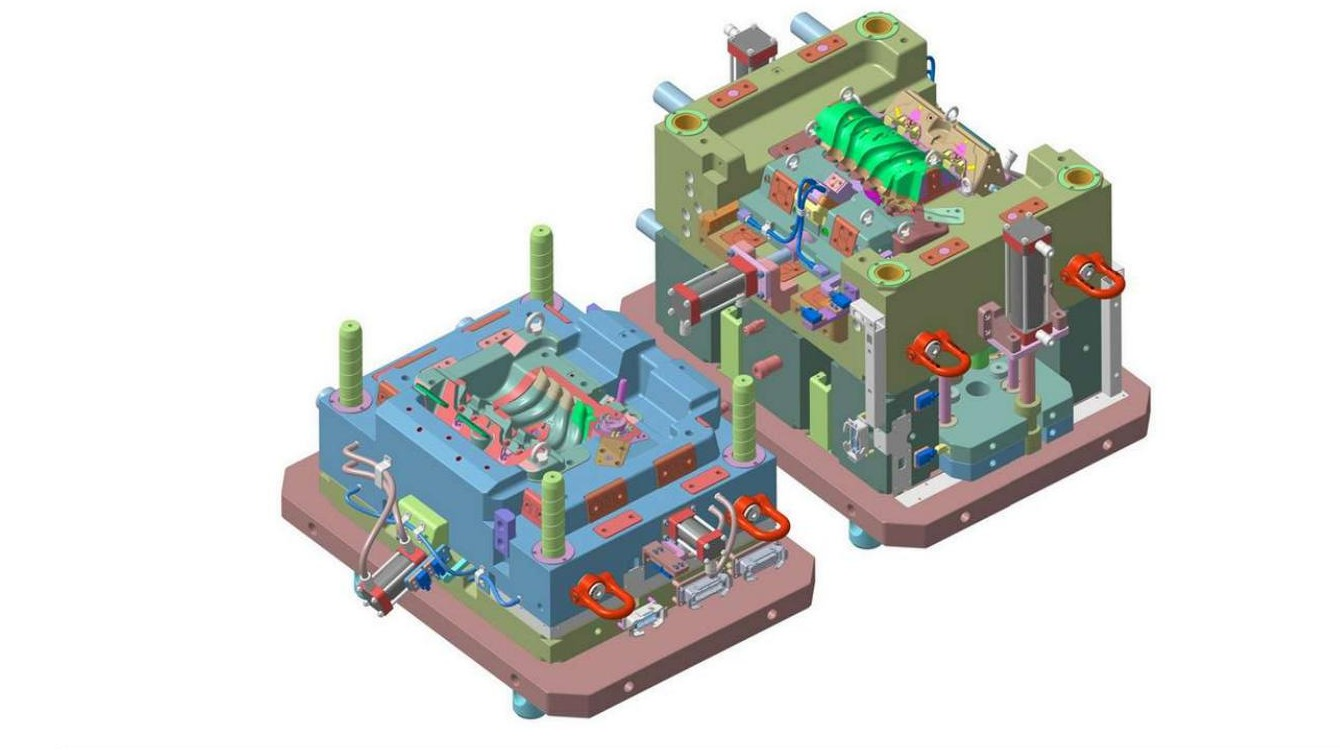
Release a complex part without distorting it
The earlier single action configuration produced visible warpage and dimensional drift. The redesign had to separate the contact faces in a controlled order so each undercut cleared before ejection loaded the part.
- Part condition
- Undercuts and internal features required more than one release motion.
- Quality risk
- Asymmetric demoulding loads were driving warpage.
- Production requirement
- The mechanism had to remain repeatable at the intended moulding cycle.
Make each mechanism move only when the previous condition is clear
Latch lock plates, angle pin slides, position monitored core pulls, tapered guide locks and the ejector return system were coordinated as one controlled opening sequence.
- 01
Open
The moving plate begins the controlled separation.
- 02
Clear slides
Angle pin slides release the external undercuts.
- 03
Retract cores
Position monitored core pulls clear the internal geometry.
- 04
Eject
The ejector system completes release after the part is unconstrained.
Find interference in CAD, not in hardened steel
The full opening cycle was simulated in CATIA V5 with constraints applied to plates, slides, ejectors and core pull cylinders. Geometry was adjusted where motion conflicts appeared before drawings were released.
- Timing
- Latch lock plates A and B, slides, core pulls and ejection were verified as one sequence.
- Feedback
- Hydraulic and pneumatic core pulls used position feedback so the next motion could not begin before the cores were clear.
- Guidance
- Tapered guide locks, stopper and kicker controls maintained alignment and controlled ejector timing.
- Clearance
- Moving elements were sequence verified to the ±0.1 mm demoulding clearance requirement.
Engineer the sequence around the production duty
The release mechanism was developed as part of a production mould, so motion timing, clearance, surface finish, service life and handover documentation were defined alongside the mechanical sequence.
- Cycle time
- 32 to 40 seconds including injection, cooling and the sequenced ejection cycle.
- Clearance
- ±0.1 mm demoulding clearance, verified across the moving elements in the sequence.
- Surface finish
- Ra 0.8 to 1.6 µm on cavity and functional surfaces, machined and polished as required.
- Tool life
- Portfolio design specification of 1.5 to 2.5 million shots, dependent on processed material and maintenance.
- Handover
- STEP and DWG files, assembly sequences, operation manuals and troubleshooting guides.
The first trial confirmed the designed release sequence
The mould was built by the OEM tool maker and the first trial reproduced the simulated sequence. The part released cleanly and the tool entered production without the previous warpage condition.
- Trial result
- Sequencing performed as simulated at first trial.
- Part quality
- Production parts met the customer dimensional and surface requirements.
- Cycle duty
- The production tool met the intended operating cycle envelope.
Warpage was solved by controlling when the part became free
The critical improvement was not one stronger component. It was the order of motion: each contact condition was removed before the next action could load the part asymmetrically.
A production mould that released cleanly
The completed mould moved from simulated mechanism sequence to successful first trial and production use, with the previous demoulding warpage eliminated.
- Sequence
- Slides, core pulls and ejection operated in the intended order.
- Quality
- Parts were produced within the customer dimensional and surface specification.
- Production status
- The mould was built, trialled and placed into production.
- Handover
- The tool maker received STEP and DWG files, assembly sequences, operating guidance and troubleshooting documentation.